7 min· building· water· consulting
The problem statement I couldn't unsee
For seven years in mining I could always answer the question: here are your top hundred customers, by name. Then I moved to water and found the answer did not exist. It took five years and a client's question to turn that from an irritation into a company.
For seven years I could answer the question.
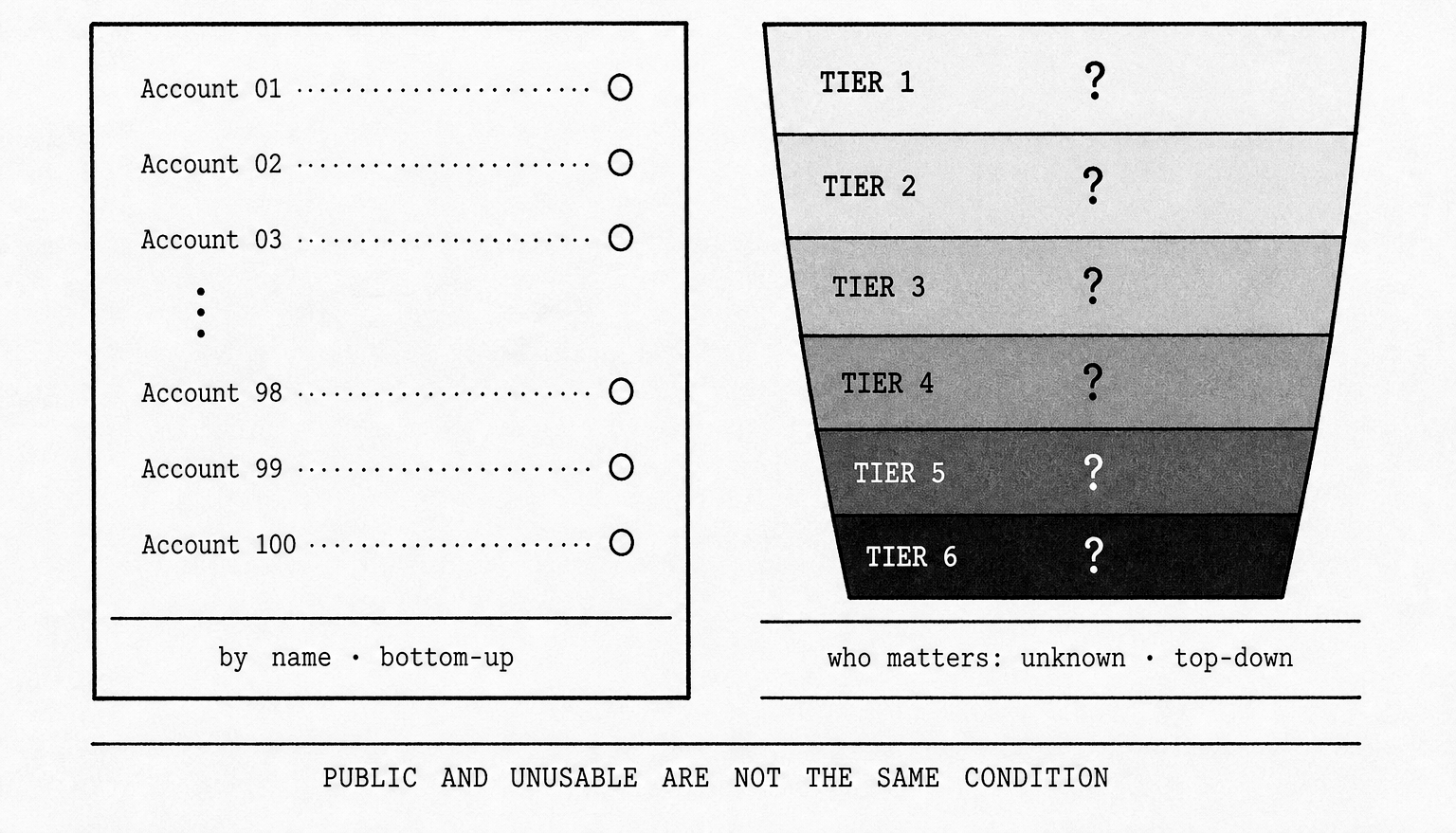
From 2012 to the middle of 2019 I worked at a European strategy firm, Bryanston, later Singular, which at the time focused on mining and metals. The work took me around Europe, Africa and the Middle East. When a client asked who their customers were, we told them by name. The firm had built a proprietary database of every mine and every steel plant, so a go-to-market study started from the real population and worked upward: bottom-up market sizing, target segments defined against real assets. Here are your top hundred accounts, here is why, here is the order to approach them in.
I did not think of that as a capability. I thought of it as what the work was.
Then I changed sectors
In January 2020 I joined Amane Advisors, the leading strategy firm in the water sector, covering North America. Over four years I led around thirty strategy projects across the value chain (drinking water, wastewater, industrial) for most of the significant vendors in the space, plus diligence work for private equity.
The first thing I noticed was that the data was not there at all.
The water market in the United States is about 50,000 drinking water utilities and 16,000 wastewater utilities. That figure is in every report. What no report tells you is which of them matters to you.
So a market study went differently. We would take a top-down number from one of the research houses, the same figure everyone else had. We would segment by population tier, because population was the only variable available for all of them. We would add a qualitative description of the kinds of utility that might plausibly buy what the client sold. And then we would hand it over.
That was as far as the work could go. It was the leading firm in the sector and the projects were rigorous, but the foundation the analysis needed did not exist in a usable form.
The information was public. Every one of those utilities publishes board minutes, capital plans, budgets and rate studies. It was all there, scattered across tens of thousands of municipal websites and buried in PDFs nobody outside that utility would ever read. Being public did not make it usable, and that gap is what this company works on now. But getting here took five more years.
The question I could not answer
What turned it was a client.
They made water meters, a large manufacturer, the kind of company that sells into hundreds of utilities a year. They were describing a problem in their sales motion, and it was not the one I expected.
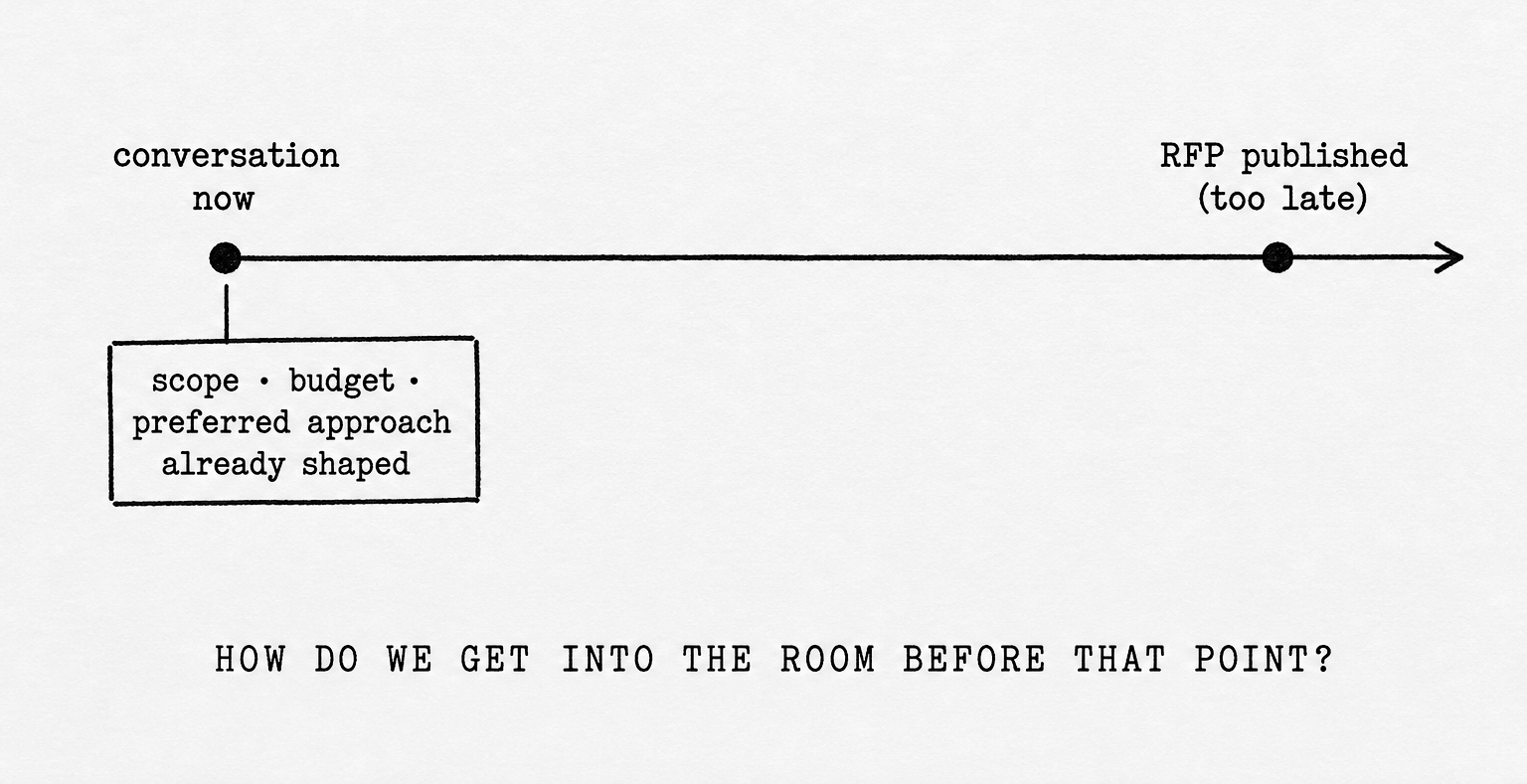
They already subscribed to the RFP databases, all of them. Their problem was that by the time a request for proposal is published, the important decisions have been made. The scope is written and the budget is allocated. Often a preferred approach has been shaped by whoever was in the room eighteen months earlier. Arriving at the RFP means arriving to compete on price for something someone else specified.
So they asked me: how do we get into conversation with that utility two to three years before it gets to that point? I did not have an answer.
For a consultant that is unusual. The whole job is having the answer. You are engaged, at considerable expense, on the premise that you will arrive at a view. I had spent twelve years doing that across two sectors, and this was one of a small number of times I was genuinely stumped, and not "we need another two weeks of analysis" stumped, but the thing you are asking for cannot currently be produced by anybody stumped.
It kept bugging me. I left in February 2024 when Amane was acquired by Roland Berger (a decision I had been putting off for longer than I like to admit) and spent the next stretch running a small cross-border fund. The question stayed with me the whole time, even though it was no longer my job.
What made it a company rather than a grievance
In the end, three things.
First, the question had a shape. "The water sector needs better data" is a complaint. The question was: for this specific utility, what are the opportunities that could become a procurement in the next two to three years, and why? That is answerable from public documents, by someone who knows how to read them.
Second, I had been the customer. For four years I had been the person who could not answer it, sitting in front of clients who needed it answered. I had felt the absence directly and repeatedly, in front of people paying for a different answer, so I did not need a market map to tell me the demand was there.
Third, the reading was the hard part, and the reading had just become tractable. Someone could always do this work by hand: sit with a utility's board minutes and capital plan for a week and produce something genuinely useful. There had never been a way to do it at the scale of a sales territory. That changed.
Why this one
I did not choose this problem over other problems. I decided I wanted to be a founder, and then found I had exactly one problem to be a founder about.
In February a friend asked whether I wanted to join them as a co-founder. I said yes, let us try it. They lived close by, so we could work in the same room, and for six weeks we did. We ideated, argued about what the first version should contain, and worked out who the customer was, what the value proposition was and how to pitch it. Building something out of nothing is a completely different activity from assessing something someone else has built.
I enjoyed it enormously, and what I learned was about me rather than the idea. I had spent twelve years on the other side of the table, running diligence on other people's companies, writing checks into them and advising them. Six weeks of doing the thing told me something that a decade of being close to it had not.
It was also where I started using the AI tools properly, working through the plan and the shape of a first version. That mattered more than I realized at the time. By the spring I could build far faster than I had any right to, which turned out to be its own trap.
We parted ways in the end, over timing and because the team was not complementary in the way a founding team has to be. Better to find that out in week six than in year two. But I came out of it wanting to do it again, and needing something to do it with.
There was only ever one candidate. The question I could not answer for that metering client had been sitting there since 2020, and it was the only problem I knew well enough to have earned an opinion about.
I went for a walk with my wife and told her I thought this was what I needed to do.
That was the whole decision, and it is less romantic than the version where a problem is so compelling it drags someone out of a comfortable career. I worked out what I wanted to be, and this was the problem I already had.
The unglamorous part
Noticing a problem is the cheap half. I noticed this in 2020 and did nothing about it for five years.
And when I finally did, I got the first version wrong. I built the whole platform in five days, could not ship it, and had to tear almost all of it out before anything was worth paying for. The problem statement was right the whole time, and that counted for less than I expected.