The day GWI launched WIN
A friend sent me the article announcing that the biggest name in water intelligence had launched into the space I was building in. I never opened it. On the strength of a headline I decided my founder journey was over, and spent the next two months planning a fund instead. When I finally read it, three months later, it took ten minutes to see I had been wrong.
In September 2025 a friend, a former colleague, sent me an article. The Water Environment Federation and Global Water Intelligence had launched something called the Water Investment Navigator.
I did not open it. I saw the title, and I saw the letters GWI, and that was enough. In the time it takes to read a link preview I concluded that my founder journey was over. I had been building the same thing since May.
I had not heard it was coming, either. I learned that WIN existed and that it was already live in the same second.
Why the name alone was enough
If you have not worked in water, the names do not land, so I will explain what arrived in that message.
Global Water Intelligence is the research house in this sector. When I was a Principal at Amane and needed market data, GWI is what we used, not because it was ideal but because a bottom-up picture of the sector did not exist and their top-down reports were the best available. The absence of that bottom-up data was the most useful observation I made in four years of consulting. GWI is the firm whose reports I was reading when I noticed the gap.
The Water Environment Federation is the industry body. WEF runs WEFTEC, the conference in Chicago where, in October 2021, someone told me that once you enter water you don't leave it, and I decided they were right.
So the research house whose limitations gave me the idea had partnered with the federation whose conference made me love the industry, and between them they had launched into the space I was building in. That is what I read off a link preview. It was, I decided, the final nail in the coffin.
What I did about it
Nothing dramatic. I did not shut the company down. I did not write anything about failing. What I did was tell myself a very reasonable story: that I'd had a short stint as a founder, that it had been cute, and that this was the universe explaining the thing was not meant for me. I was going back to being an investor.
Then I went and did that, with energy. I joined the emerging managers program at Decile Hub. I spent the next couple of months working on the strategy for a second fund.
From the outside, and from the inside too, none of this looked like quitting. It looked like a founder reading a market signal and going back to the thing he was already good at. That is why I am writing it down: the giving up came with a plan attached and a program to enroll in, so it looked like good judgment.
What was true
I never opened the link, so I did not have a single fact behind that decision. The gap between what I reacted to and what was there is the most useful thing in this story, so here is how little I knew.
I did not know what WIN did, beyond the sentence in the headline. I did not know who it was built for. I did not know whether it touched the part of the problem I cared about or a different part. I had one data point (that two organizations I respected enormously had done something in water and data) and I filled in the rest myself, downward, in a few seconds.
Meanwhile the constraint that mattered to my company was nowhere in that article. What was wrong with what I had built was that I could not ship it. It needed engineers I did not have, and no amount of building alone was going to change that. I have written about that separately, in the piece about deleting almost everything. That was true in May and still true in November.
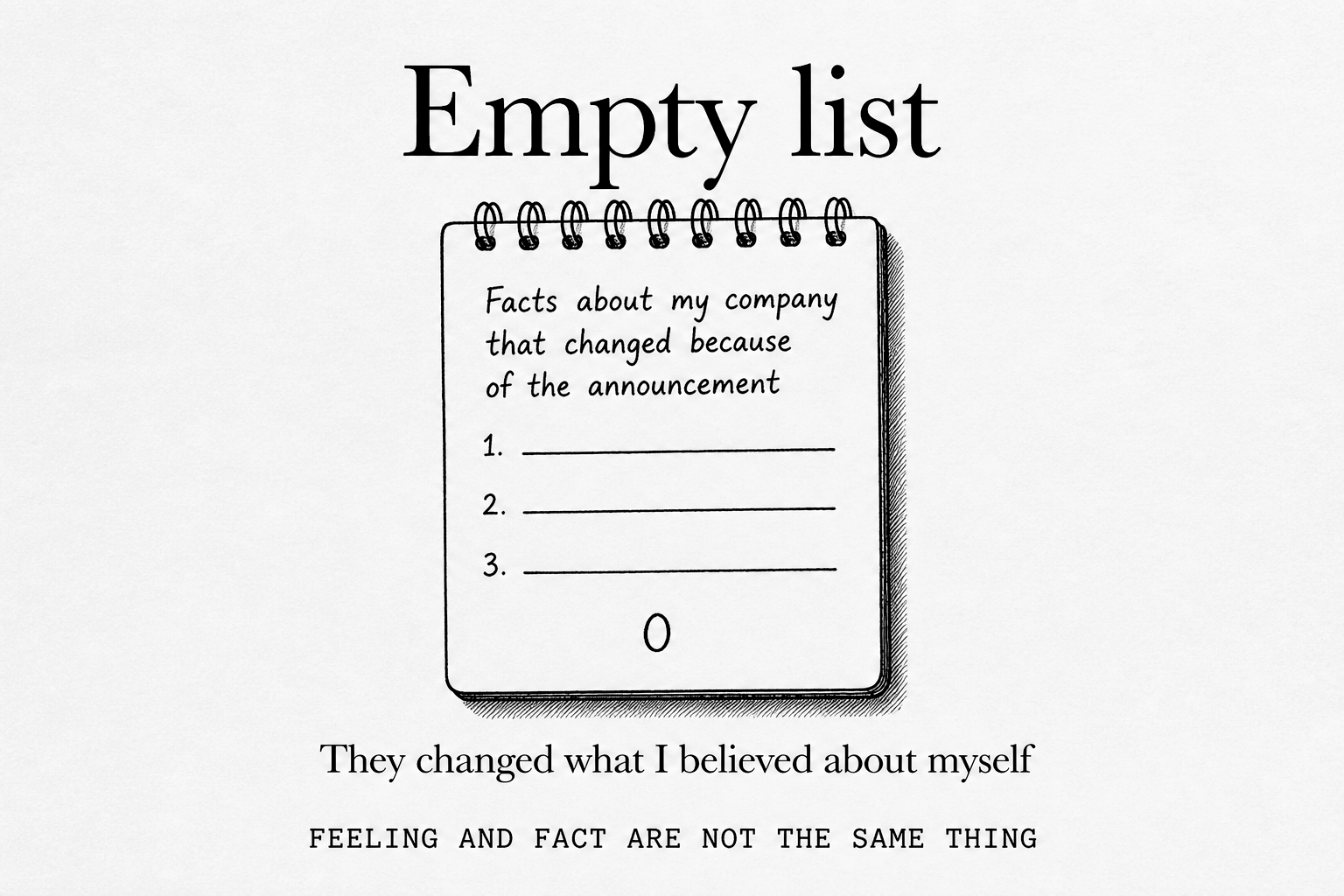
WIN did not change a single fact about my company. It changed what I believed about myself, and at the time those two felt identical.
What brought me back
It was not courage or a change of mind about WIN; I still had not opened the link. Two things happened, in this order.
First, the exit closed. We were about to launch a second fund, and we pulled the plug on it because it was early. We decided we would rather raise at a point where it was a no-brainer: an obvious track record behind us, and no grinding it out for a year to reach a first close.
I think that was the right call and I would make it again. It also meant that the sensible, mature, well-planned thing I had reallocated to no longer existed. The slate was clear and there was nothing on it.
Then somebody walked in. I had forgotten to turn the website off.
When I decided the company was finished I did not shut anything down. I just stopped. There was no winding up, because winding up is a task and I had stopped thinking in tasks. So the site I had built in the spring was still sitting there, still explaining what AquaIntel was for, still perfectly happy to be found.
At the end of November a former client found it. I had consulted for his organization years earlier, but he had no idea the company was mine. He came across the site, was interested enough in what it claimed to go looking for whoever was behind it, worked out that it was me, and got in touch.
We got on a call and he was keen: interested in the proposition and in where it could go, well beyond polite encouragement.
Somewhere in that conversation the thing I had settled in September stopped being obviously true. WIN existed and was not going anywhere. But if one person could find me by accident and want to talk, there were probably a few more. It might not be a venture-scale company, but it could be a decent business in a sector I knew, run by me, for a handful of customers. That was enough to be worth finding out about.
So I was back at the drawing board with the question of what I wanted to do, and out of that came the much smaller question that turned out to matter. Is there one thing in here that a customer would pay for, that I can deliver myself, now?
I would like to tell you I came back because I worked something out. I did not. I cleared my own calendar by accident, and then a website I had forgotten to switch off did more for this company than any decision I made that autumn.
When I finally opened it
In December, three months late and by then already back at work, I read about WIN properly. It took about ten minutes.
They are doing interesting things, and it is very well laid out. It is a serious piece of infrastructure and the sector is better for it existing. But they are a data provider and their DNA is in research, and I am building an agentic solution. Those are different journeys. We can coexist, and I was fine with what they were doing. That is a strange sentence to write about the event that had ended my company three months earlier, and ten minutes of reading would have saved me those three months.
What I would tell someone this is happening to
Open the link. I am aware of how stupid this sounds as advice, and I did not do it. Whatever you are about to conclude, you are about to conclude it from a headline and a logo, and the real product is usually adjacent to yours rather than on top of it. The reading costs you ten minutes. Not reading it cost me a quarter of a year.
Separate what you feel from what changed. Write down the facts about your company that are different now that the announcement exists. In my case the list was empty. They had not taken a customer from me, had not made my product worse, and had not touched the reason my product could not ship. If your list is full, that is real information and you should act on it. Mine was empty and I acted anyway.
What eventually corrected me was one person turning up and being interested. If you cannot argue yourself out of the conclusion, stop arguing and go and get a single piece of evidence from outside your own head. One conversation with someone who might pay you is worth more than a week of thinking, and I lost considerably more than a week.
Watch for the reasonable-sounding exit. Despair you would notice. The more dangerous response is the sensible pivot to the thing you already know how to do, arriving with a plan and a program and a feeling of relief. I got two months into one and it felt like maturity the whole way. What saved me was that it fell through on its own, for reasons that had nothing to do with any of this. I would not plan on that happening to you.
The way back is a smaller question, not a bigger one. I returned by asking for less: one thing, one customer, deliverable by me, now.
The launch of WIN was the most frightening thing that happened to my company, and it changed nothing about the company itself.