The right moment never comes
I had already decided to leave consulting. I had a horizon of six to twelve months and a fund that had been live for a year. Then my firm was acquired and I was gone inside a month. The uncomfortable part is the thirteen months before that.
I have told this story to about fifty people in the last year, always in one sentence, always the same one. The firm I was at got acquired by Roland Berger, and that's when I left. It is true, but it leaves out most of what happened.
What the one-sentence version leaves out
I had already decided to go. I had been thinking about leaving consulting for a while, and not idly. I intended to do it, and I had a horizon on it: the next six to twelve months.
The fund was also more than a plan. It was live. Callapina launched in January 2023, and I went on being a Principal at a consulting firm for another thirteen months.
What the fund gave me matters for the end of this, so here it is plainly. The fund was not income. We drew no fee from it, so there was no salary in it and there was not going to be one for years. It gave me a direction, but it gave me no financial floor.
Then, in February 2024, Amane was acquired. It came as a surprise. I was gone by the end of that same month.
The part worth noticing
When I looked back at it, what surprised me was that it was not a difficult decision.
Staying would have been interesting. Working inside a much larger organization is its own education, and there would have been things to learn. But it would have been more of the same. The fund was what I intended to spend the rest of my working life doing, and it offered more room to grow than another turn of a job I already knew how to do well. Those paths had diverged, and once they had, choosing between them took no courage at all.
That is the uncomfortable part. It was an easy call, and I had been intending to make that same easy call for thirteen months, while running the fund I was supposedly leaving to run. Nothing became clearer when the ground moved. The arguments I had in February 2024 were the arguments I had in January 2023. The only thing that changed was the deadline.
The decision was never hard. It was just never urgent.
I think most delays work this way. We explain them as difficulty (I am weighing it, it is complicated, there is a lot to consider) when most of the time the reasoning finished long ago and what is missing is a reason to act this week rather than next. A bad situation pushes you out. A comfortable one keeps offering you another perfectly reasonable quarter, and every one of those quarters is defensible. I was waiting for the right moment, and it does not come, because the conditions for a change do not improve on their own while you are still inside the thing you are changing from.
Why I already knew this
I had been through this before and did not recognize it.
In 2009 I left Bangalore for Germany, to do an MBA. New country, new culture, a language I did not speak. Nothing about it was comfortable, and it is the period I grew the most in. I did not handle it especially well. There was simply no version of it where I could stay as I was. That move I chose.
The third one is the least flattering. Between the mining firm and Amane I took several months out, and that was not a planned sabbatical either. I had spent seven years traveling more or less continuously (mines are not situated near anywhere, which is rather the point of them), and with a second child at home I had arrived somewhere I could not keep going from. So I stopped.
I did not stop when stopping became sensible. I stopped when continuing stopped being possible. It is the same pattern as February 2024: the case for a break had been obvious for a long time, and nothing made me act on it until I had to.
So, three transitions. I chose one. The other two were made for me, once by exhaustion and once by an acquisition, and in both of those the reasoning had been sitting there, fully assembled, long before the event that finally moved me. I could not tell you which route is better. I can only say that I have never grown from the comfortable option, and that on the evidence so far I do not take the uncomfortable one until something removes the alternative.
What I would take from this
I am not saying "quit your job". I did not leap into nothing, and if I had, this would be a different and much worse essay. There was a structure underneath me, and what it was surprised me. I take two things from it.
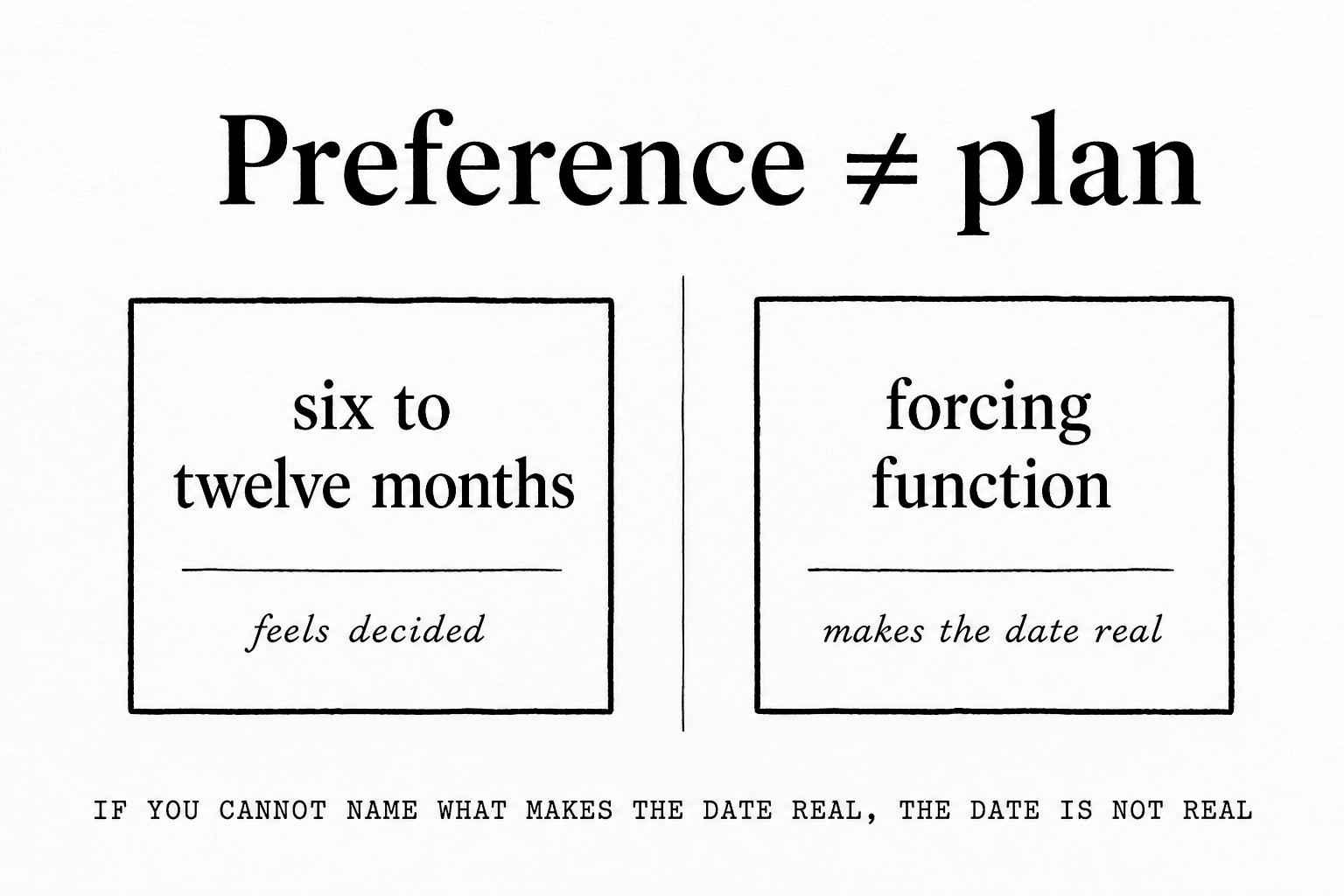
The first is that a plan with a horizon and no forcing function is only a preference. Six to twelve months felt like a decision, and it let me stay exactly where I was. If you cannot name what will make the date real, the date is not real.
The second is that the preparation that saves you is usually not the preparation you are doing. This is the one I would most like to have understood earlier.
For thirteen months I had a live fund and no intention of staying, which sounds like a man getting his affairs in order. But the fund paid nothing and was not going to for years. As a floor it was worthless. It was the thing I was consciously preparing, and it is not what carried me.
What carried me was a habit I had never thought of as preparation. I have never wanted a single source of income. For most people that single source is their job, and I had spent years deliberately not being in that position, with property, investments, freelance work and various other things. None of it was a strategy for leaving consulting. It was how I preferred to arrange my life, and I had been arranging it that way long before there was anything to leave.
So when I went, I turned to my network and put together freelance projects and advisory work, helping companies with business development and with entering the US market. Income came quickly, because producing income from several places at once was something I had been doing for years, not a new skill I had to learn under pressure.
To recap: the fund was the preparation I was aiming at the jump, because it was what I wanted. What caught me was the spread of income I had built for no particular occasion, which never felt like readiness because it was not pointed at anything.
If you have a plan with a horizon on it, two questions are worth asking yourself this week. What would make the date real? And if something outside your control moved it to next month, where would your income come from?