Is there one small thing here worth paying for?
In May 2025 I built the whole thing in five days and it looked like an enterprise product. In November I deleted almost all of it and asked a much smaller question. That question now has four paying customers.
AquaIntel was incorporated in Delaware in May 2025. That same month I started building and did not really stop for five days.
I was up until four and five in the morning, in flow, building on Replit. At the end of it I had the thing. It did everything I had wanted it to do. It looked like an enterprise version of the product — the full platform, the modules, all of it.
It was also never going to ship.
Not because it failed in the demo. Because turning that into something production-grade needed human developers, and I did not have a team. I had built a very convincing picture of a company rather than something a customer could buy.
That is the part worth being precise about, because the speed is real and so is the trap. Five days took me further than five months would have in 2019. It also took me further from a saleable product than I understood at the time, because every module I added made the eventual engineering job bigger.
The question
At the end of November I came back to it. I did not try to fix the platform. I took out almost all of the modules — everything that was good to have — and asked one question:
Is there one thing in here that is genuinely a differentiator, that a customer would pay for, that I can deliver myself, now?
Not eventually. Not once I have engineers. Now.
The answer was the opportunities.
Everything else was supporting cast. The thing with real value was this: from a vendor's point of view, what are the opportunities at a given utility that could become an RFP in the next two to three years?
That is what a vendor wants to know. It is what they would pay for. And it was the one part of the system that rested on judgment about the water sector rather than on engineering capacity I didn't have.
The smallest possible test
The first idea was a newsletter. Pick four or five utilities, analyze them, publish weekly, let vendors subscribe.
It never launched. As soon as I did the analysis for one utility, the profile itself turned out to be the product and the newsletter fell away.
That utility was Gettysburg, Pennsylvania — a town of about ten thousand people. I read everything they had put into the public domain: board minutes, capital improvement plans, financial reports. Out of that I identified five opportunities. Five things I believed they would want solved in the coming years.
I put them into a profile. A report, really.
It took about a week.
What happened next
I started sending it out. Companies I already knew in the sector, then cold outreach on LinkedIn to people in water I had never met.
I had about forty conversations across December and January.
That is what kept me going. Not a plan and not a raise — the fact that when I showed strangers a report about one small utility in Pennsylvania, forty of them wanted to talk.
How I knew this was different
I had been encouraged before. Earlier in AquaIntel's life I had feedback that sounded a great deal like validation and turned out to be politeness and curiosity. So the obvious risk was that a full calendar was the same thing wearing a better suit.
It wasn't, and the difference is specific enough to be worth naming.
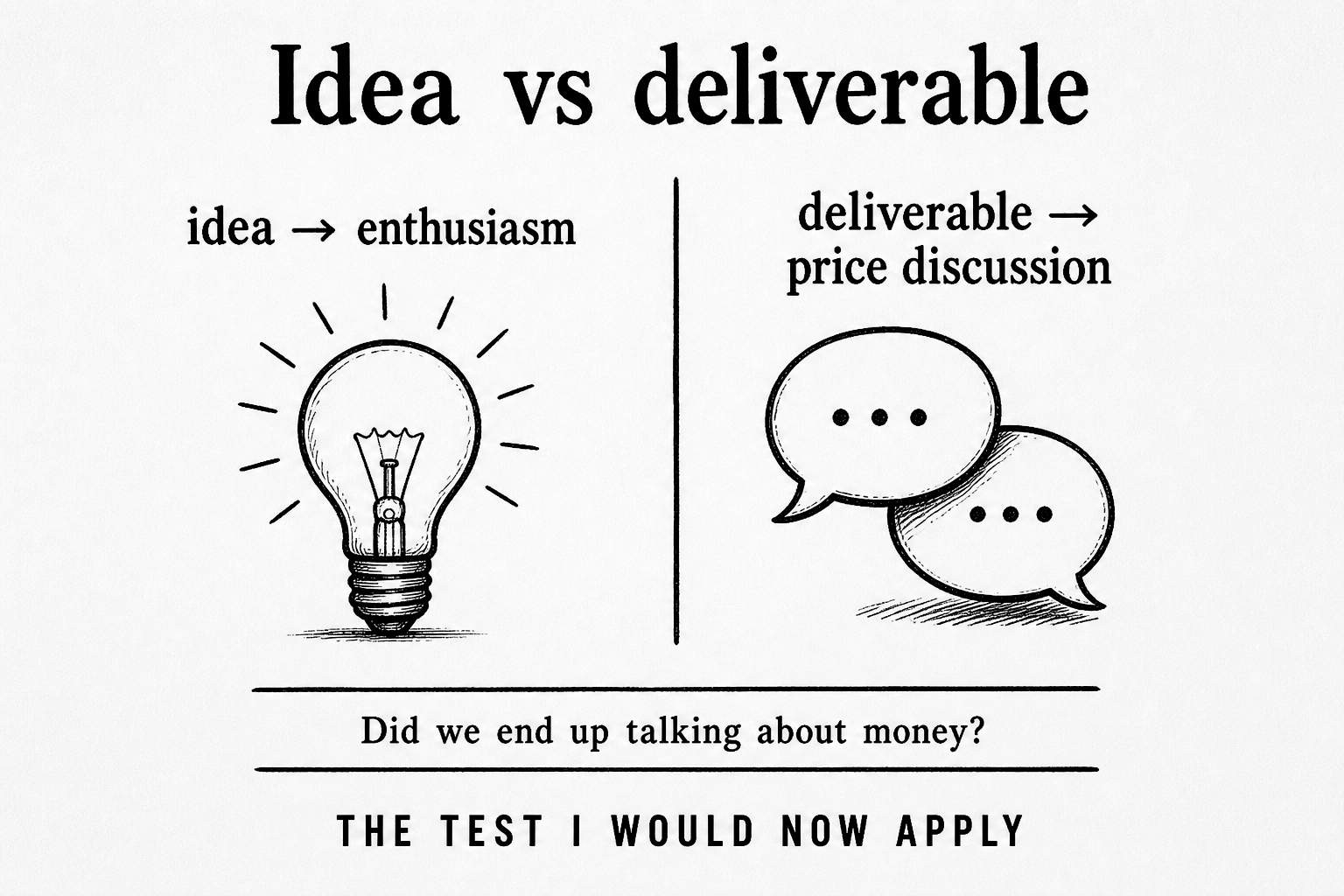
The earlier feedback was on an idea. This feedback was on a deliverable. People weren't reacting to a description of what I might build. They were reading five real opportunities at a real utility and telling me whether the insights were any good — and the insights weren't available to them anywhere else. That is a much harder thing to be polite about. If the analysis is wrong, a vendor who sells into water utilities knows immediately.
And then the conversations moved to price. I started getting signals on willingness to pay, and I was able to test pricing levels — actual numbers, with people who would be the ones paying them.
That is the test I would now apply to any encouraging conversation. Not did they like it but did we end up talking about money. An idea generates enthusiasm. A deliverable generates a price discussion, or it tells you quickly that there isn't one.
The signal was right
I am writing this with the benefit of knowing how it went, so I should say plainly what happened rather than leave it at the calendar filled up.
The first customer paid in March 2026 — four months after the teardown. There are four paying customers now, and two of them are enterprise.
That last part is the bit I did not expect. The whole point of the exercise was to find the smallest thing someone would pay for — I assumed that meant small customers, small checks, a long climb back up to the platform I had deleted. It didn't. The small thing turned out to be the way in rather than the ceiling. You lead with the one piece of work that is unambiguously valuable, and the size of the customer sorts itself out.
Four customers is not a business yet. It is five months of revenue and a long way from the thing I had built in May. But it is the difference between a signal and a result, and the route between the two ran through deleting almost everything.
The whole sequence took nine months: incorporate in May, build the wrong thing by the end of that week, spend six months finding that out, tear it down at the end of November, hand-write one report in a week, have forty conversations, and take the first payment in March.
What I would tell someone else
If you have built something that demos well and cannot ship, don't go looking for the missing engineer. Look for the smallest piece of it that a customer would pay for and that you can deliver yourself this week.
Then deliver it, by hand, to one customer. Mine was a report about a town of ten thousand people, assembled in a week out of documents anyone could have downloaded.
The platform may still be the eventual answer — and I am closer to it now than I was when I had actually built it, because something is paying for the next piece. That is the whole lesson. You don't get to build the platform until something is paying for it, and five days of flow state will not change that. It will only make it feel like it has.