10 min· consulting· building
Buy the plane ticket
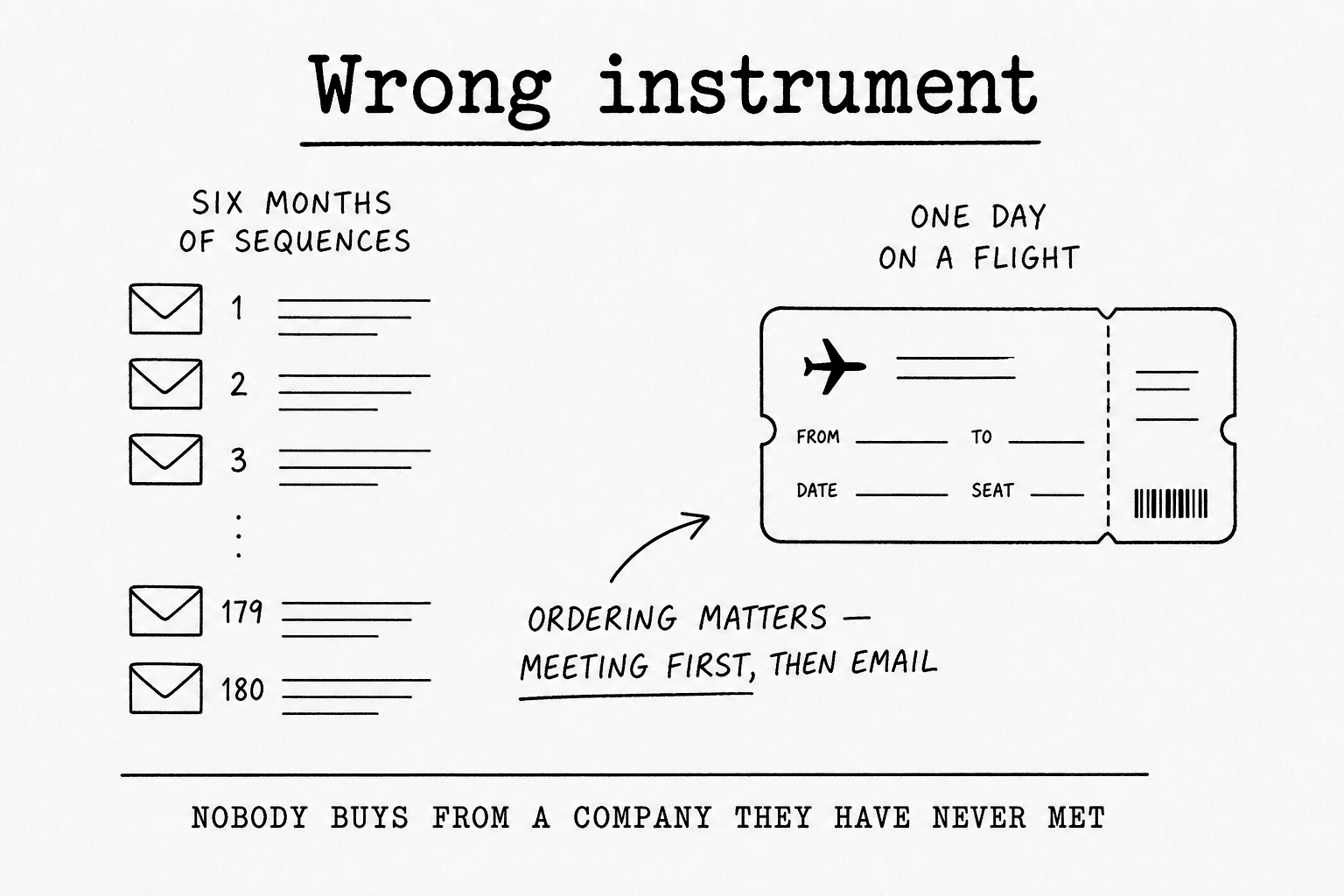
I have helped three Indian companies in their efforts to sell to the US market. What stops them is that nobody buys from a company they have never met, and founders will spend six months on email sequences before they will spend a day on a flight.
Over the last few years I have helped three Indian companies in their efforts to sell to the US market. One makes industrial filtration materials. One is a B2B software company. One builds industrial energy infrastructure. The products, buyers and price points were all different, and all three hit the same wall.
All three were selling B2B, into enterprise or large institutional buyers, and that sets the clock for everything else. These are relationship sales with long procurement cycles. There is no version of this where a good email produces a quick order, and the founders who struggle most are the ones who arrive expecting a transaction and find they have signed up for a courtship. You have to treat it as a long-term investment.
The wall was never the entity, the visa, the tax structure or the bank account. Those are the things everybody writes about, and they are tedious, but they are solved problems with known answers and people you can pay to handle them. The wall is that nobody buys from a company they have never met.
What the distance costs
A US buyer looking at an unfamiliar overseas vendor has a quieter question in mind than whether the product works: if this goes wrong, who do I call, and how bad will it be for me personally?
You cannot answer that question with a website. You are asking someone to take a career risk on an organization with no local presence, no local reference they recognize, and, if things go badly, no local anything. Every part of your company that would normally reassure a buyer is eight and a half time zones away.
That is the real content of "trust and credibility": a specific and reasonable assessment of who carries the risk. At the start, the answer is that the buyer does.
The mistake, stated plainly
I have now watched the same pattern three times. Founders over-invest in go-to-market email campaigns and under-invest in a flight ticket to the US.
The email campaign is appealing. It is cheap, it is measurable, it scales, it can be built from your desk in Bangalore, and there is an entire industry of tools and playbooks that will help you do it. You can spend six months getting very good at it. You will have open rates and reply rates and a sequence that is being A/B tested, and you will be able to show your board a chart.
But for a first US customer, from an unknown overseas company, cold email alone does not work. The emails can be good; the problem is that the message arriving is trust me, and email is the wrong instrument for that message from a stranger with no local footprint.
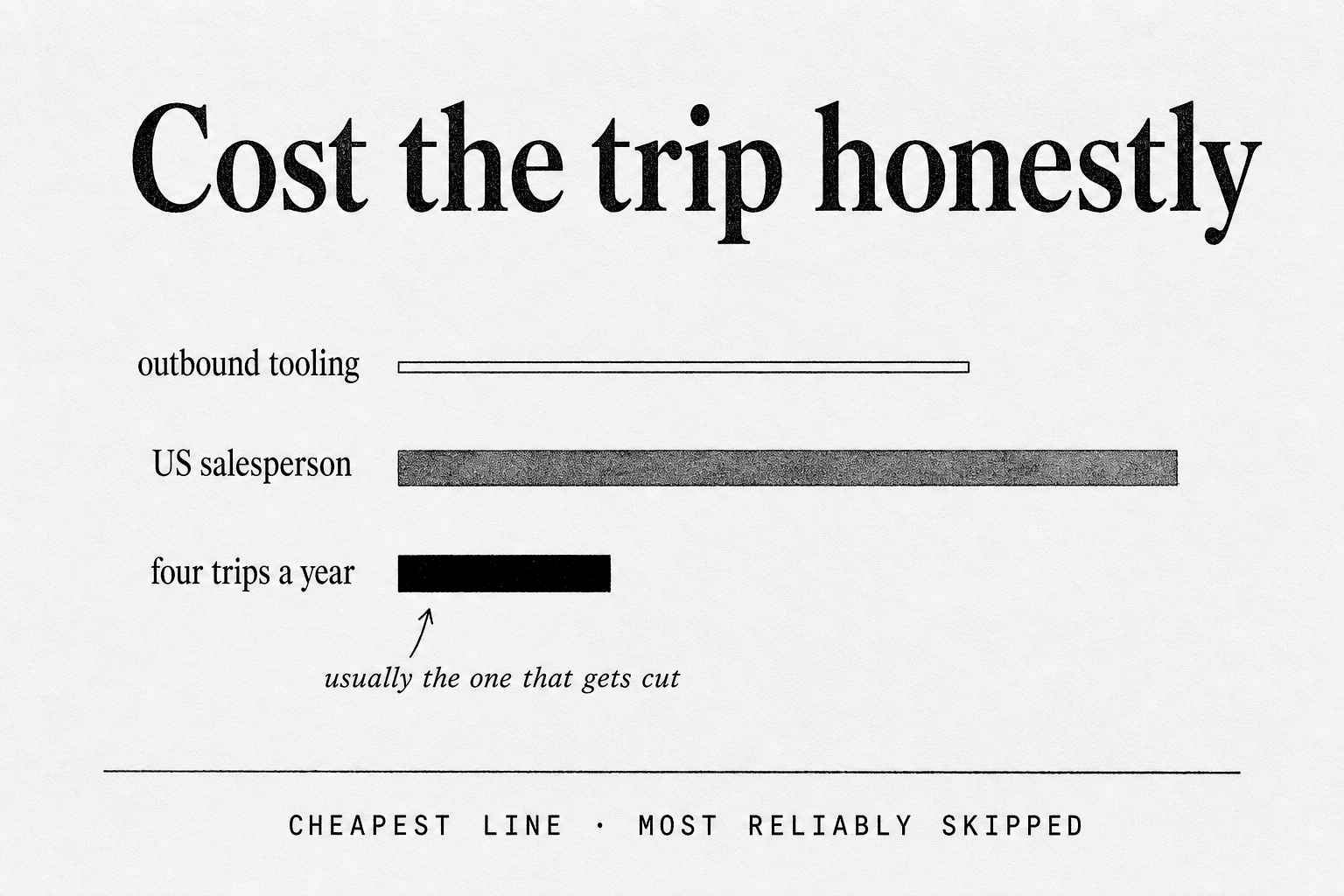
Meanwhile the flight costs a fraction of what the campaign costs, and the trade show costs less than a quarter of the tooling budget, and neither has a dashboard, so neither gets funded.
The other expensive way to avoid the trip
The second instinct is to hire. An experienced US salesperson will cost you somewhere around $200,000 to $250,000 all in. Having hired them, they will then spend six to nine months generating leads. In other words, they will be doing from a standing start the exact thing you were trying to avoid doing yourself, for a company they have just joined and cannot yet vouch for from personal experience.
That is not a solution either. You are still avoiding the trip, only at a much higher cost.
And you will probably get the hire itself wrong. Assessing a US enterprise salesperson (whether their network is real, whether their last number was theirs or their employer's, whether they can sell something unproven) is a judgment made on instinct about a market you have not yet been in. Almost everyone gets that first hire wrong, and doing it from Bangalore makes it close to a coin toss.
The hire makes sense later, just not as the first move. Made first, you are buying somebody's network and credibility before you have anything for them to be credible about, and paying a quarter of a million a year for the privilege of still not having a US reference customer at the end of it. One month of that salary buys several trips.
What worked
What worked was showing up. For one of those three companies I generated about a million dollars of sales over two years, and the mechanism was not clever. It was going to the trade shows where their customers already were, meeting people in person, following up with people who now had a face to attach to the company, and doing that repeatedly until a first order happened and then a second.
Meeting face to face converts an unknown foreign supplier into a person the buyer has met, so the buyer is no longer taking a risk on an abstraction.
None of this is an argument against outbound. Once someone has met you, email works fine; it is the follow-up, and follow-up is exactly what email is good at. The error is the ordering. Founders try to use email to earn the meeting, when the meeting is what makes the email land.
The other thing that worked
Showing up is not the only route, and for the software company it was not the main one.
What worked there was a relationship they already had with a very large US technology company, as a channel partner. That took a different kind of effort: understanding how a big organization is put together, finding several points of contact inside it rather than one, helping each of them understand what the product did, and looking for the places where selling it alongside their own made sense for them.
It is slow, unglamorous work and it is not automatable either. But it solves the same problem by the opposite route. Instead of building your own credibility in a market that has never heard of you, you borrow somebody's who already has it. The buyer's quiet question (if this goes wrong, who do I call) has a different answer when a company they already trust is standing next to you.
So both routes are relationship work, and neither is a volume play. What varies is whose relationship you are using.
The part that is harder to fix
There is a second problem underneath the first, and it is worse because it is invisible from where the founder is standing. Sitting in India, you have no idea what the US market is like.
I don't mean the size of it, which is in every report. I mean how it behaves: who signs, what a procurement cycle looks like and how long it really takes, which objections are real and which are polite deferrals, what a buyer means when they say they will circle back, what your competitors are charging as opposed to their list prices, and which trade show matters and which one is a room full of other vendors.
You cannot read your way to that, and you certainly cannot infer it from a market report. It is acquired by being in the room, repeatedly, and it is the reason the trip pays for itself twice: once in the relationships, and once in finally understanding the market you have been guessing about.
I have written elsewhere about the data that does not exist for the US water sector, meaning the bottom-up picture of who your customers really are. A company entering from overseas has that problem in its most acute form: it is working from no map at all, and it usually does not know it.
Do not waste the meeting you flew for
Everything above gets you into the room. What you do with the room is a separate discipline, and it is the one I have watched squandered most often.
Do the work first. Define who your ideal customer is, as a specific profile rather than "US utilities" or "US manufacturers": what size, in which states, running what already, under pressure about what. Build a target list from that rather than from whoever happens to reply. Then research the individual organizations properly: what they have published, what they have bought in the last two years, and what they have said they are worried about, in public, in their own documents. Then turn up knowing all of it.
The alternative is getting on the call and asking the customer to explain what they do. That is a question they have answered a thousand times, and it tells them you are using them as your research, after two flights and a trade show booth to get there.
The same mistake shows up in what you send. One standard deck, one standard offer, the same slides to every prospect. Until recently that was a defensible economy, because adapting the material thirty times over was expensive in hours nobody had.
With the tools now available, rebuilding the pitch around a specific customer (their pain points, their requirements, the language they use about their problems) costs very little. So the generic deck no longer reads as efficient; it tells the buyer you have not looked at them. The tailored one stands out, because almost everyone still sends the other kind.
This is also the cheapest credibility available to a company nobody has heard of. You cannot manufacture a local track record before you have one, but you can walk in understanding their situation better than the last three vendors did. That registers because it is rare, and because it does not require you to already be established.
What I would tell a founder
Cost the trip against the alternatives. Put four trips a year next to your annual outbound tooling and agency spend, and then next to a $200,000-plus salesperson. The trip is the cheapest line on that list by an order of magnitude, and it is reliably the one that gets cut.
Do the homework before you book the flight. The ideal customer profile, the target list, the research on each organization. The trip is the expensive part; preparation is what decides whether it returns anything.
Send them something that is about them. Send the version built around their situation instead of the standard deck; it now costs a fraction of what it used to.
Go where the buyers already are. Trade shows are unfashionable, but they are where the people who sign are physically standing, so for three days the hardest part of the problem is solved.
Send the founder, and do not hire the salesperson yet. The buyer's real question is about the company's commitment and durability, and a founder in the room answers it in a way a new hire cannot. Hire once there is something to sell into: a reference, a repeatable pitch, a reason for a good salesperson to believe you. Hiring before that spends the money and still leaves you waiting.
Expect the first customer to take longer than the plan says, and fund it. The first US reference is the expensive one. Everything after it is easier, and almost nobody budgets for the difference.
What I got wrong
I did not arrive at any of this by insight. I did the thing I have spent this essay telling you not to do.
Starting out, I ran the cold email play myself. I built the lists and sent the sequences, and the replies did not come. Everything above about why it does not work is something I could have told you in the abstract beforehand and had to learn anyway, at somebody else's expense as well as my own.
What changed was the order: trade show first, meet people and shake hands, and then get on the Zoom call to follow up.
A video call that follows a handshake is a different meeting from a video call that follows a cold email, even when the words are identical. I had been trying to run the second one and wondering why it did not convert.