I did not design the roadmap
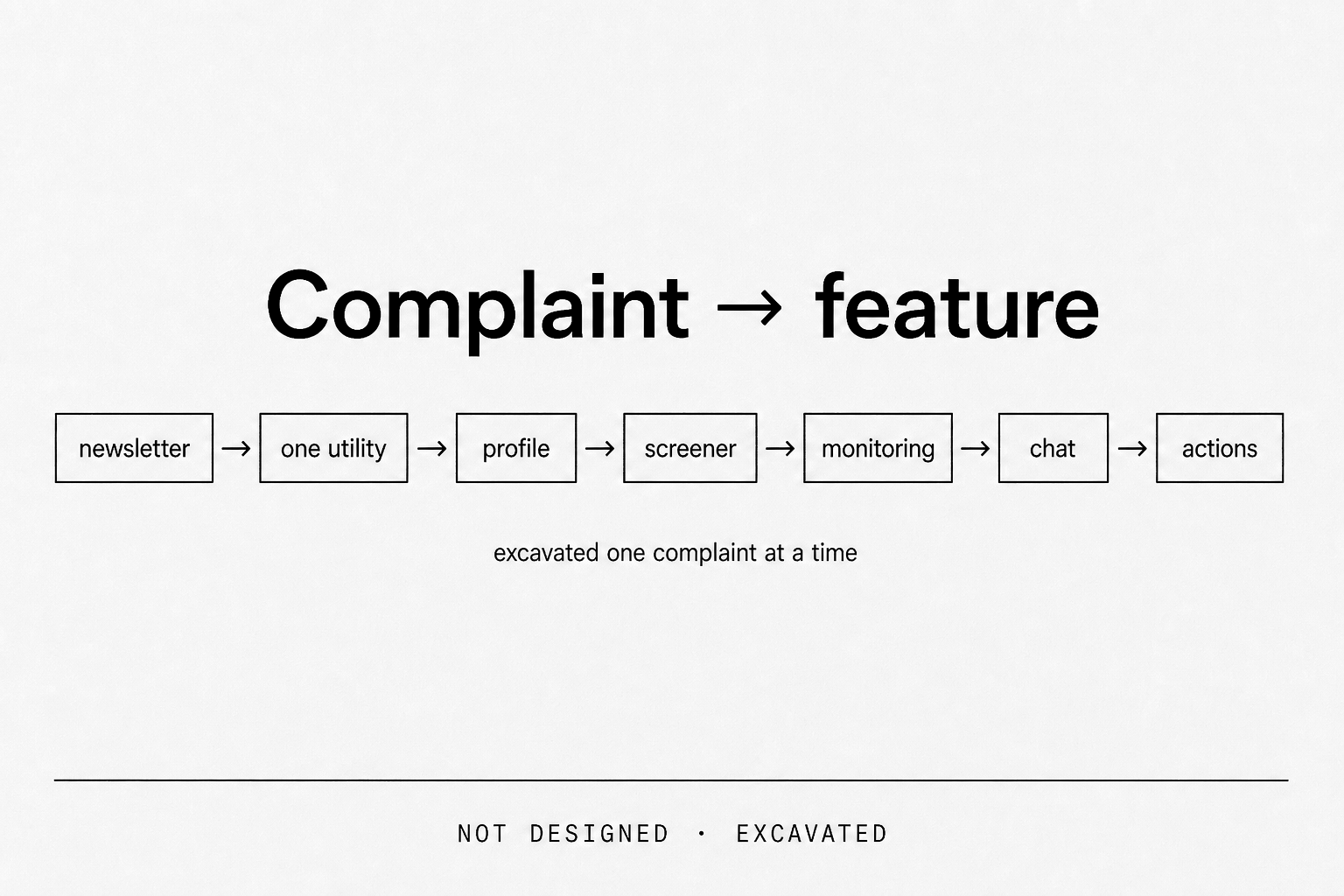
A weekly newsletter became a newsletter about one utility, which became a profile, which became the product. Every feature after that came from a customer complaining about the last one. And the two products I started alongside it showed me the lesson of the teardown was not the one I had taken from it.
I did not design the product I sell now. Customers found it for me, one complaint at a time, without knowing that was what they were doing. This is the sequence.
Three versions of a newsletter
The first idea was a weekly newsletter: five opportunities, drawn from across the utility market, sent to vendors who sell into it.
That became a newsletter about five opportunities at a single utility, which is a smaller and stranger thing to send someone.
And that became the utility profile: the same five opportunities, but as a document about one organization rather than a bulletin. At that point it stopped being a newsletter at all, and the newsletter never launched.
Three versions, and the only thing that survived from the first was the number five.
Then I started sending it to people
This is the part that did the work. I sent profiles to prospects, got on calls, and asked what they thought.
They told me. Because I was showing them something concrete rather than describing an idea, what came back was requests more than encouragement: more features, different cuts, things they wished it did.
Some of it was already on my roadmap. Some was already built. But a good deal of it was new, and I wrote it all down immediately.
From the outside those months look like a plan being executed, and they were not. There were a lot of conversations and a lot of interest, and it was still not clear what exactly the product was. That is an uncomfortable thing to sit in for weeks while sounding confident on calls.
Every feature, and the complaint that produced it
Looking back, I can trace each piece to something a customer said.
A screener, and then AI search. People wanted to slice the market by things no report contains. Everyone has population. They wanted how many miles of pipeline, what kind of meters, and whether the utility has signaled any intent to deal with PFAS. Once you want to filter on facts that only exist buried in documents, you are building search over things nobody has structured yet, and a filter is no longer enough.
Ongoing monitoring. A profile is a good baseline and it is static. The utility keeps having meetings after I hand you the document. So the profile had to stop being a document and start being a position that updates.
A chat agent. Customers kept coming back with follow-up questions, sharper than the ones I had anticipated, because they knew their own business. They wanted to interrogate the report they had more than they wanted a better one.
An actions layer. This one came from thinking a step ahead about our own feature. If monitoring works, it produces alerts, and a salesperson buried in notifications will ignore all of them within two weeks. So every alert has to resolve into specific actions for sales and marketing, which someone can then assign and own. Without that, the alerts get ignored.
And one deliberate refusal: we are not the CRM. Every one of those decisions needs to be recorded somewhere, and there was an obvious temptation to become the place where it is recorded. We decided early not to. We integrate with the CRM and let it stay the system of record. It is a smaller product that way, and a much easier one to adopt.
None of that was foresight. I put a real artifact in front of people and then listened properly to what annoyed them about it.
Two more products, which looks like the old mistake
While all of that was going on, I started two other things.
One was Memora, an events app for the offline half of the job. The logic: everything the main product does is online intelligence, but sales in this sector happens at conferences, where a great deal of context is generated and almost none of it survives. You are three days into an event, you have had forty conversations, and by the following week most of it is gone. So the app helps you discover which water events matter, prepare properly for the ones you attend, see who is speaking and whether anyone you are tracking will be there, and take notes in the moment that become pipeline actions afterwards. We engaged an agency to build it.
The other was Permit Navigator, which automates permit applications, built for an engineering consulting firm in the water sector. A real problem, and a completely separate product.
Four months after deleting almost everything I had built, I was building two more things. On the surface that is the same behavior that got me into trouble the first time, and I want to be careful not to let myself off lightly. When I look at where each one stands, though, the difference is the useful part.
Memora is built. The first version is ready to publish on both app stores, it has been tested with multiple customers, and they want it. What remains is seeding the event data, a beta group, and their feedback. It is adjacent and complementary to the main product rather than another module inside a platform nobody had yet bought.
Permit Navigator was built for a specific customer, who has given good feedback, and it is close to shipping. It can produce revenue now, which bootstraps the company. And the engine underneath it extends directly into prefilling RFPs, which is the main product's own direction, since the entire thesis is being present before the RFP exists.
So in May 2025 I built modules because I could imagine somebody wanting them. In 2026 I built two things because somebody specifically did, and each has a route back: one to the core product, one to the bank account. That is the whole distinction, and restraint has little to do with it.
What I would take from it
Do not write the roadmap in a room. Write the smallest real thing you can hand to someone, hand it over, and then write down what they complain about. The complaints arrive in order of importance.
Be careful, too, which lesson you take from your own failures. For a while I thought the moral of the teardown was build less: that the error had been ambition, and the corrective was restraint. That is the obvious reading, and I think it is wrong. Two of the things I started in the months right after it would fail a build-less test, and both were correct.
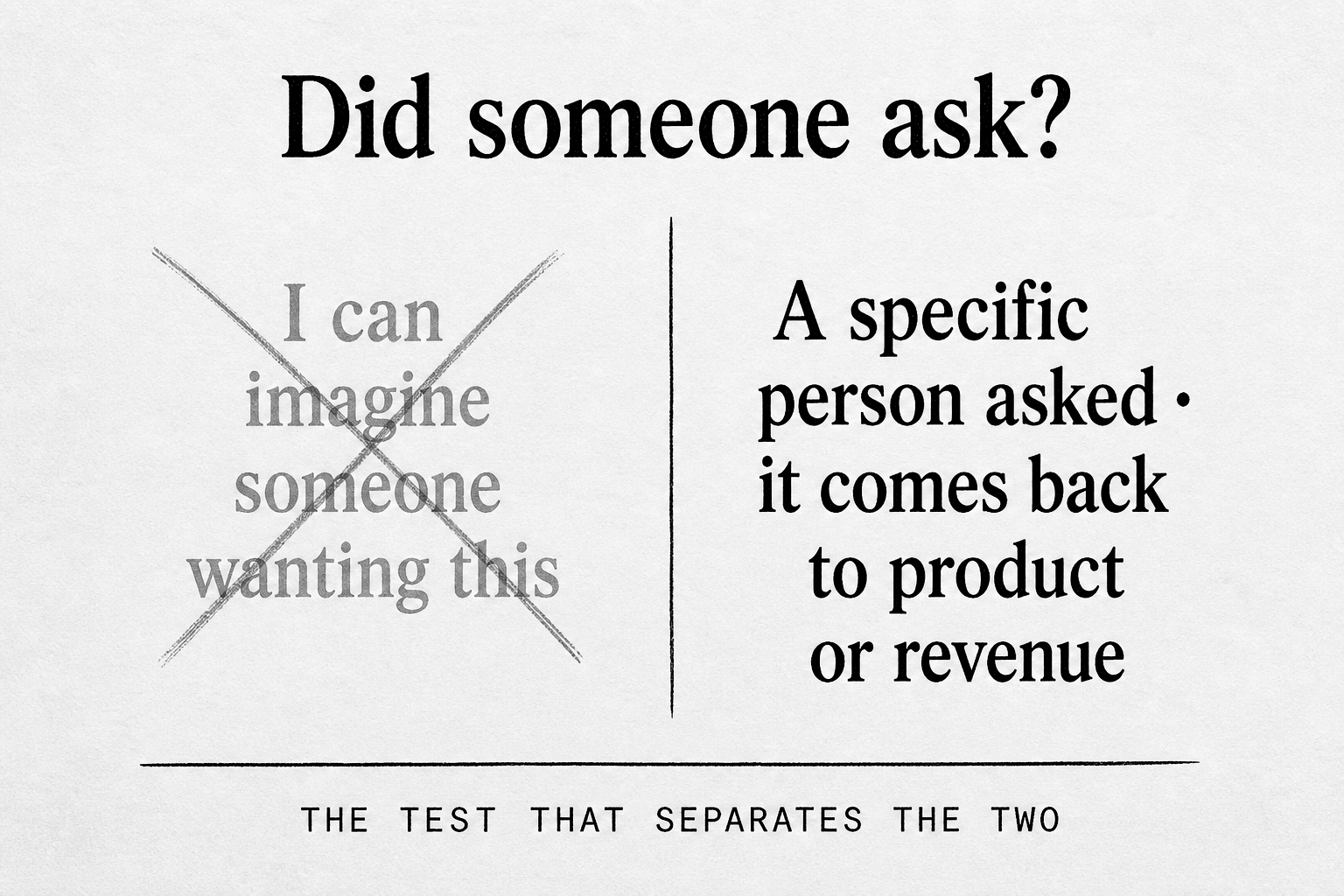
The error was never the number of things. It was building what I could imagine someone wanting. The test I use now is narrow: did a specific person ask for this, and does it come back to the product or to the revenue? Everything I deleted failed that test. What I have kept since, including the parts that look like sprawl, passes it. If you are looking at your own roadmap this week, that is the question I would put to each item on it.