7 min· water· consulting
Water is the next gold
I moved into water at 36 on the strength of a phrase I'd heard someone say. Two months later the world shut. Six years on, it's a different phrase that explains why I'm still here.
I joined the water sector in 2020, at 36, from a management consulting firm that did mining and metals. I was looking for a change. I had heard someone say that water is the next gold, and that was, if I am honest, most of my thesis.
I'll admit I hadn't thought much about everything that happens in the background each time you turn on a tap.
I stayed four years. Three things surprised me, one thing happened to everybody, and by the end it was a different phrase entirely that explained why I was still there.
One: it isn't narrow
I expected a niche. Water sounds like one thing, and from outside it looks like a focused industry with a handful of players.
It is nothing of the sort. Our client base ran from pump and valve OEMs to water treatment technology companies, infrastructure companies, utilities, digital companies, chemical companies, D2C and residential brands, and private equity funds investing in water.
Those businesses have almost nothing in common commercially. A company selling valves to a municipal plant and a fund underwriting a water infrastructure asset are not in the same industry in any sense that matters to how you advise them. Every project was different. I had expected the opposite: a small sector where you learn the shape once and then repeat it.
Two: there is no data
This is the one that took me a year to properly understand, and it was the hardest adjustment.
In mining and metals I was used to granular, bottom-up analysis. We had the data: the mines around the world, their output, and the steel plants they sold to. You could size a market from the bottom up, mine by mine, and segment it properly. That is how I had learned to work.
Water has nothing equivalent. What exists is top-down — research reports from GWI and a few other firms, and that is largely what we relied on. There is no comparable bottom-up picture of who the utilities are, what they spend, and what they are about to buy.
We talked about this internally more than once. If someone built a database of all the water utilities, you could finally do bottom-up market sizing and segmentation in this sector the way you can in mining.
I have been thinking about that ever since.
Three: where are the startups?
I came in with an investor's habit, so one of the first questions I asked was where the water startups were.
The answer, from partners who had been in the industry for decades, was: there aren't many. And the reason is structural. It is difficult to scale a company in water because of how fragmented the customer base is and how hard the go-to-market is — long procurement, small budgets, thousands of buyers who each have to be sold to individually.
That was a discouraging thing to learn in month one, and it took me a while to notice that it is the same fact as the second surprise. There is no data because the market is fragmented. It is hard to scale because the market is fragmented. One problem, wearing two hats.
And then, two months in, the world shut
A new project was about to kick off. Over a single weekend, COVID arrived and everything stopped. Projects were canceled. The one we were starting fell over before it began.
The personal adjustment was sharper than the professional one. I had spent seven years living out of a suitcase — Europe, the Middle East, Africa, wherever the mining work was. That was the job and it was most of my life. Now I was locked in a house.
It took a couple of months to get the project back on track, and when it restarted it was a different job: strategy work delivered remotely, over Zoom. For the next eighteen months I did not meet a single client in person.
That is a strange way to run a high-touch business. Strategy consulting is built on being in the room — reading a board, noticing who defers to whom, having the conversation that happens after the meeting rather than during it. We learned to do without all of it, and the work still got delivered, which was its own surprise.
And I should be honest that a lot of it was better. After seven years of suitcases I was around my family properly for the first time in my working life. The flexibility was real. I did not miss a single hour stuck in traffic. The thing the mining job had quietly taken from me, the pandemic handed back — which is an uncomfortable sentence to write about a period that was so bad for so many people, but it is true.
We got used to it. When hybrid arrived it turned out to be the right settlement, and it is still how I would choose to work.
But you do feel the absence of the room.
WEFTEC, Chicago, October 2021
My first water industry event was WEFTEC, in Chicago, in October 2021.
It was surreal. Eighteen months of faces in windows, and suddenly all of those people were standing in front of me. Clients I had delivered whole projects for and never met.
What struck me was the warmth. This is a genuinely welcoming industry — more so than any other sector I have worked in, and I have worked in a few. People are generous with introductions, generous with what they know, and unbothered about who gets credit. Some of that is because it is small enough that everyone will meet again. Most of it, I think, is because the work is obviously worth doing.
Someone said to me at that event: once you enter water, you don't leave it.
The four years
I helped build the US office from fewer than five people to more than ten, and the business grew roughly threefold in revenue and clientele. I became a Principal and co-led the firm's innovation offering, which was the part of the job closest to what I had done as an investor — finding companies with something genuinely new and helping them scale it.
So was the phrase true?
Not really — not the way it sounds.
"The next gold" is a phrase about extraction and price. It implies a commodity trade: something gets scarcer, the price rises, you buy early. Water does not work like that and mostly cannot, because it is a public good delivered by roughly fifty thousand utilities in the US alone, most of them small, most of them under-funded, and almost all answerable to someone who has to stand for election.
The scarcity is real. The mechanism for acting on it is nothing like a commodity market. You do not buy water. You solve a problem for the people who have to deliver it, at a price they can actually pay.
So the phrase that got me in turned out to be the wrong one, and the phrase I heard at a conference in Chicago turned out to be the right one.
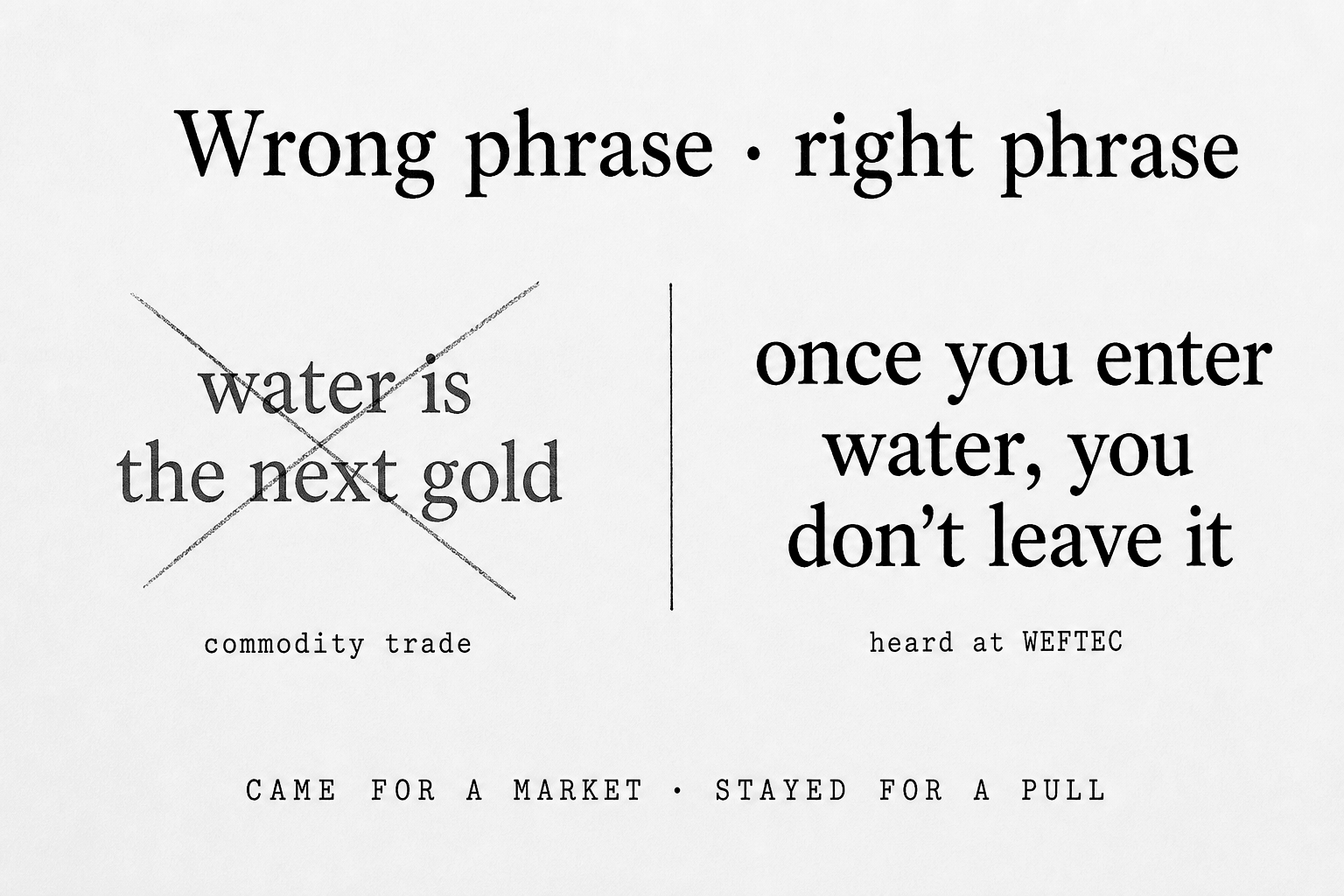
I came for something that sounded like a market. I stayed for something I still cannot fully explain — a pull back toward it that I notice most when I am looking at anything else.
And the specific gap I noticed in year one — that nobody could tell you, from the bottom up, what fifty thousand utilities are actually about to spend money on — is what I eventually started a company to fix. It took me five years to do anything about it, which in hindsight is a long time to sit on the most useful observation I had.
But I didn't leave.