8 min· water
Two backlogs, one blind spot
Utilities carry debt in their pipes and in their data, and the data debt makes the pipe debt harder to see.
In March 2025, the American Society of Civil Engineers gave US drinking water a C- and wastewater a D+. Both grades are the same as in 2021. In the same report card, ASCE notes that only about 30% of utilities have fully implemented an asset management plan.
I think those two facts belong together. Utilities carry two backlogs, one in the ground and one in their records, and the second one hides where the first one is worst.
1. The backlog in the ground
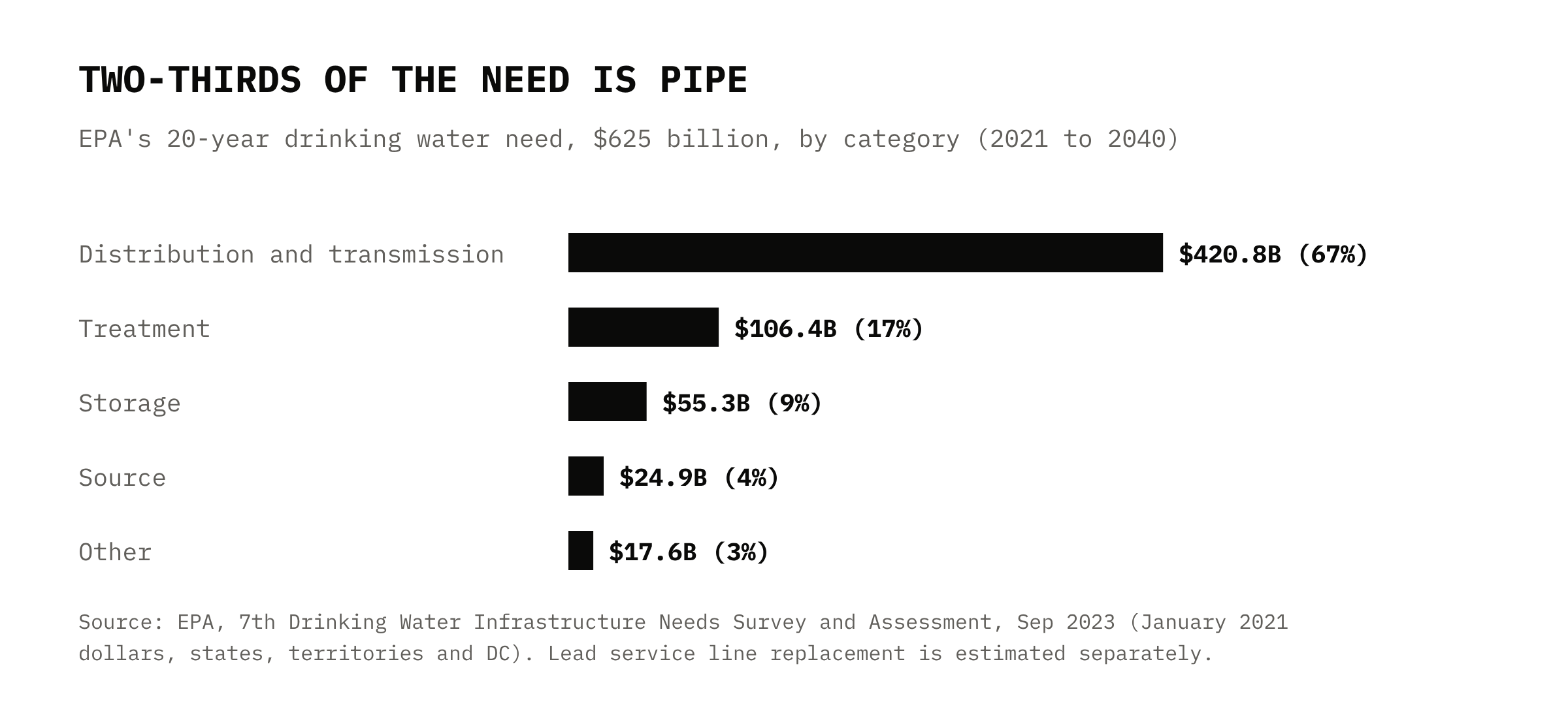
EPA's seventh Drinking Water Infrastructure Needs Survey, published in September 2023, puts the 20-year capital need at $625 billion (2021 to 2040, in January 2021 dollars). Distribution and transmission account for $420.8 billion of it, about 67%. Pipes are the bulk of the bill.
ASCE counts about 240,000 water main breaks a year, at roughly $2.6 billion in repair and maintenance costs. It says nearly 20% of installed water mains, a little more than 450,000 miles of pipe, have passed their useful lives.
AWWA's 2026 State of the Water Industry survey ran from September 21 to October 31, 2025. Aging infrastructure renewal and replacement ranked as the top concern. Of 468 utility executives, 49.6% said asset renewal, rehabilitation and replacement is currently funded. The report's own words: "this relatively low number is concerning and suggests deferred maintenance may be building up." The data side is thinner still. Digital solutions are currently funded at 34.3% of those utilities, and 42.4% of utilities have a digital transformation strategy fully implemented or in progress.
2. The backlog in the records
The second backlog is smaller in dollars. It sits in old billing systems, in GIS layers that lag behind the field, in condition data kept in spreadsheets, and in asset records that are still on paper.
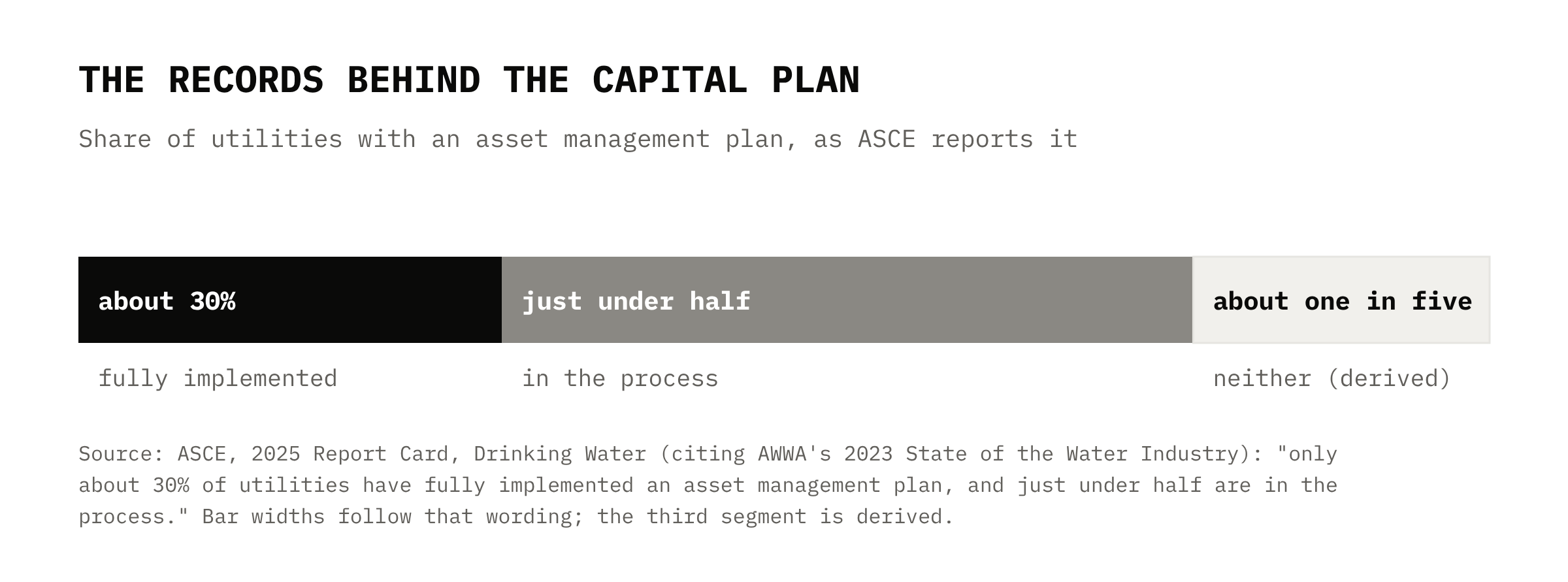
An asset management plan runs on that data: what each pipe is made of, when it went in, how often it broke, and what is around it. ASCE, citing AWWA's 2023 survey, says just under half of utilities are still in the process of implementing a plan, on top of the roughly 30% that have one in place.
The people who hold the records in their heads are also leaving. A 2024 EPA working group report to Congress says one-third of US water utility operators will be eligible to retire within the next 10 years.
3. Prudent debt, and debt nobody chose
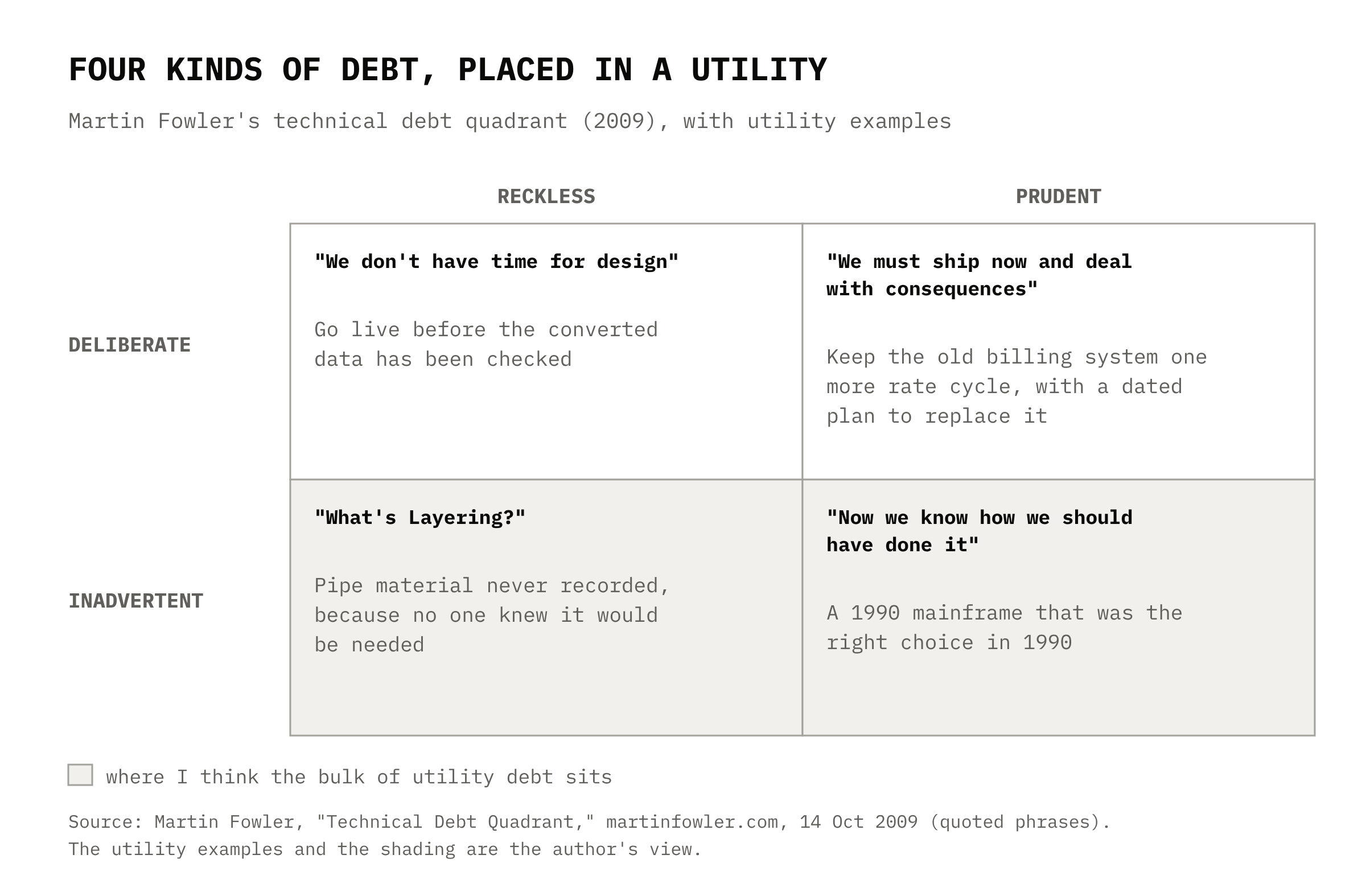
Martin Fowler, a software writer, sorted technical debt into four boxes in 2009: reckless or prudent, and deliberate or inadvertent. His example for the prudent and inadvertent box is the line "Now we know how we should have done it." For the reckless and inadvertent box, it is a team that never learned the right way to build.
I think the bulk of utility debt sits in the two inadvertent boxes. A paper or mainframe record system was a sound choice when it went in, and only later did we learn what it would cost. Some of it is reckless and inadvertent, where a record was never kept because no one knew it would be needed.
4. Where the two backlogs meet
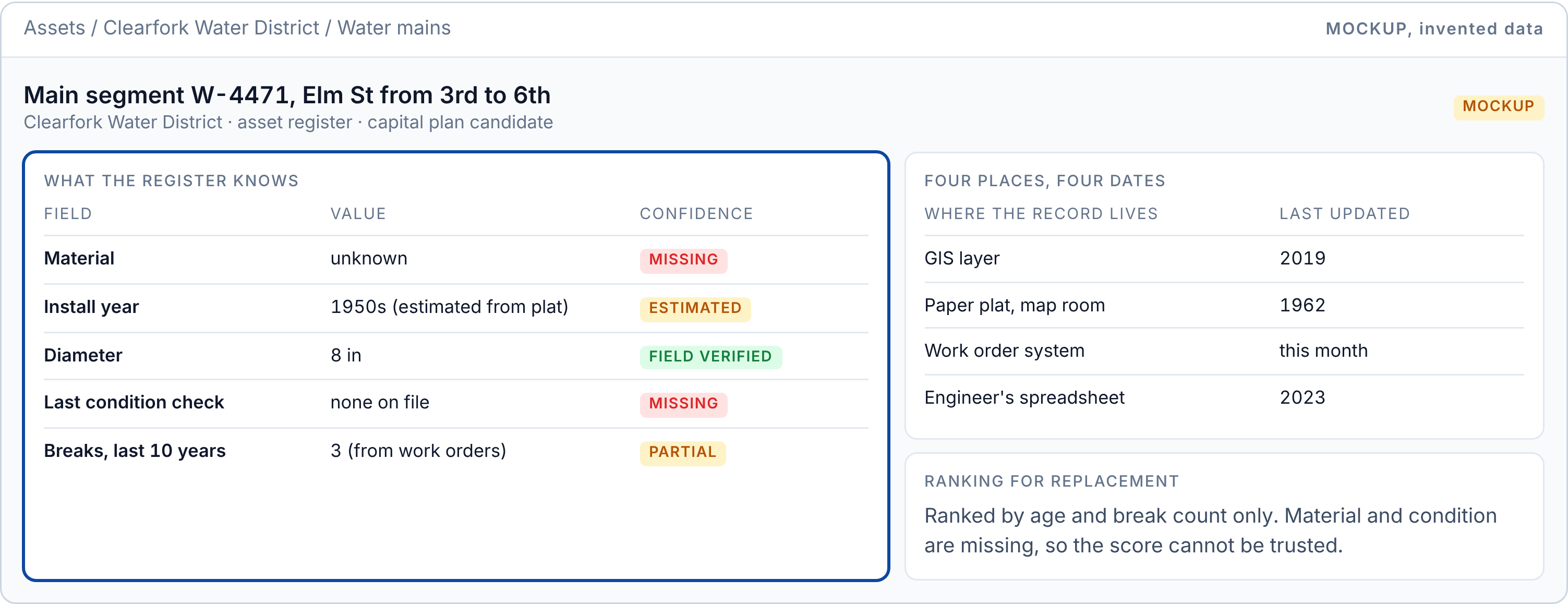
This part is my judgment, and I have no study to cite for it. When the data on a pipe network is incomplete, a utility replaces pipe by age, by the last break, or by the loudest complaint. Some of that money goes to pipe that had years left, and some of the risk stays in pipe that nobody flagged. The pipe backlog then costs more than it should, because the data backlog decides the order.
One utility's own budgets show how long the data backlog can sit. WSSC Water's FY2020 budget said the asset half of its systems program would replace "multiple existing applications for tracking assets, service requests, work orders, inspections and patch tickets," and "help improve our decision making on replacing, rehabilitating and refurbishing our assets." The independent report on the program says about $15.8 million went into that release before it was dropped. The FY2022 budget funded "replacement of the aging Maintenance Management Information System," which WSSC's FY2013 budget had listed among its mainframe systems. The FY2027 proposed budget, published in 2026, still lists "work and asset management" among the "legacy systems" it plans to modernize.
The same budgets show what good data on a pipe is worth, and how easily it gets cut. In 2008 a large main broke along River Road in Montgomery County. WSSC's FY2023 proposed budget calls it "the 2008 massive break along River Road requiring the rescue of numerous motorists." WSSC now monitors its large prestressed concrete mains with acoustic fiber optic systems that "collect and record PCCP wire breaks and alert WSSC Water when pipes are in danger of failure so immediate action can be taken." Its PCCP condition assessment program "targets approximately 18 miles of pipe each year," and the budget says it "has been instrumental in avoiding water main failures of large PCCP." For FY2023, WSSC built its proposed budget on a 7% rate increase, which it said required "over $133 million in additional cuts." One was $0.5 million for that monitoring. Another was $110.5 million to rehabilitate, replace and upgrade aging infrastructure. In its own words, the cut "increases risk of large-diameter pipe failures like the 2008 massive break." That is the blind spot in one line: when money is tight, the data that tells you which pipe will fail is cut alongside the pipe.
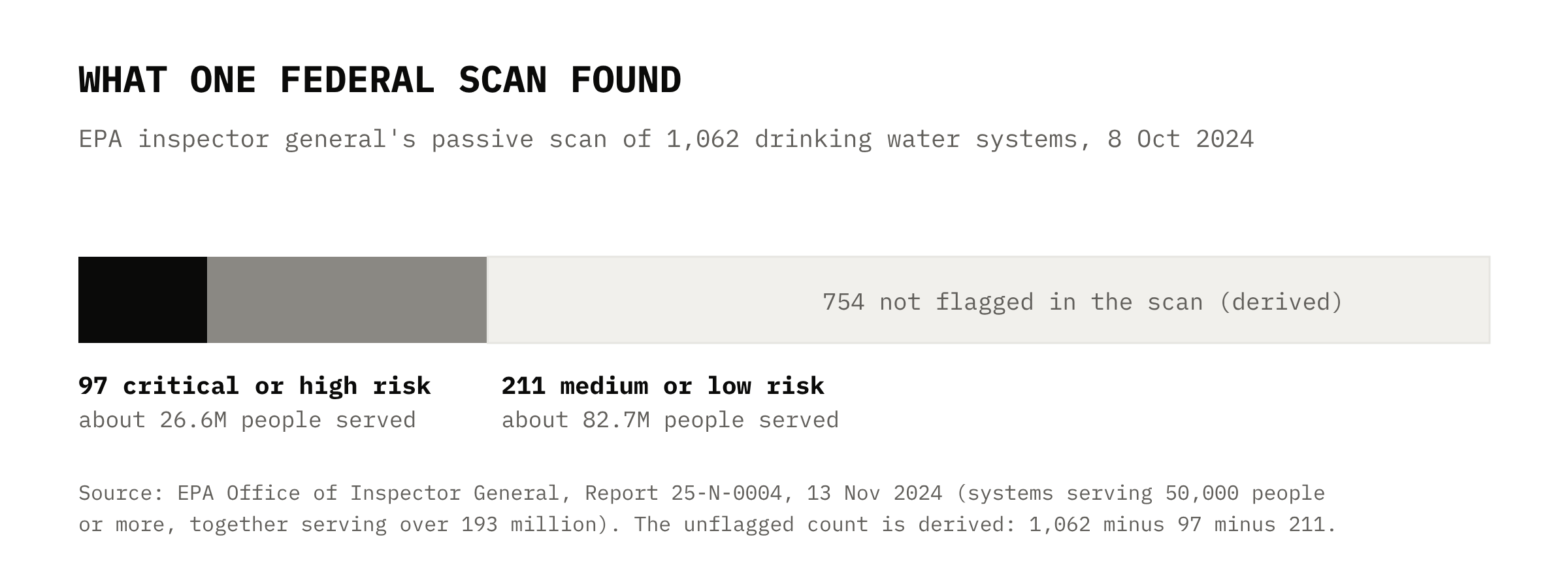
The two backlogs also meet in the control room. In October 2024, EPA's inspector general scanned 1,062 drinking water systems that serve 50,000 people or more. It found 97 systems, serving about 26.6 million people, with critical or high-risk cybersecurity vulnerabilities. In December 2024, EPA and CISA described how hacktivists in 2024 reached internet-exposed operator screens at water systems, "maxed out set points," "turned off alarm mechanisms," and changed passwords "to lock out the water utility operators." Microsoft ended support for Windows 10 on October 14, 2025. I have found no public count of water sites still running it. I have seen utilities in Georgia that still run on Windows 98.
5. What it means for utilities
The data backlog is the cheaper of the two to pay down, and paying it down tells you where to spend on the other one. Three questions help you find it:
- Which systems hold your billing, asset and GIS data, and how old is each one?
- Which reports do staff still build by hand in spreadsheets?
- Who knows how the oldest system works, and what happens when they retire?
6. What it means for vendors
If you sell pipe, meters, condition assessment or treatment, the state of a utility's records shapes when and how it buys. In my view, a utility with a current asset register can tell you which mains it plans to replace and why. A utility without one is still working that out, and the first project it buys may be the data.
Ask about the asset register early in discovery. The answer tells you how far the utility is from a capital decision.
7. What to watch next
- AWWA's next State of the Water Industry report, usually released in the spring. Watch the share of utilities funding asset renewal.
- EPA's next Drinking Water Infrastructure Needs Survey, on EPA's DWINSA page. Watch whether the distribution share of the need moves.
- Board agendas that mention GIS, asset management software or condition assessment. In US utilities these studies usually come before the big replacement contracts, because the money that pays for replacement asks for them. EPA's asset management guide starts there: "The first step in managing your assets is knowing their current state." Pennsylvania's Clean Water SRF requires borrowers to evaluate "the condition and performance of inventoried assets" and gives extra ranking points to applicants with an asset management plan. An award for condition assessment or asset software is often the first public sign of a replacement program.
The WSSC budget lines above come from the public records we collect at AquaIntel. Read year by year, WSSC's budgets show the same asset system coming back.
I would start with the records. They are the smaller bill, and they decide how the bigger one gets spent.